

As technology environments expand across cloud platforms and security domains, maintaining deep expertise in every required area has become increasingly difficult for internal IT teams to manage alone. This challenge reflects a wider skills shortage across Australia. According to the Australian Computer Society (ACS), the national technology workforce exceeded one million workers in 2024, yet Australia will require 1.3 million tech workers by 2030 to meet demand across digital and cyber roles.
In this environment, organisations need access to specialist expertise without surrendering ownership of their technology environment. Co-managed IT services address this gap by extending internal capability with targeted skills, operational scale and enterprise tools, while control, accountability and decision-making remain firmly in-house.
Australia’s Growing Need for Tech Skills
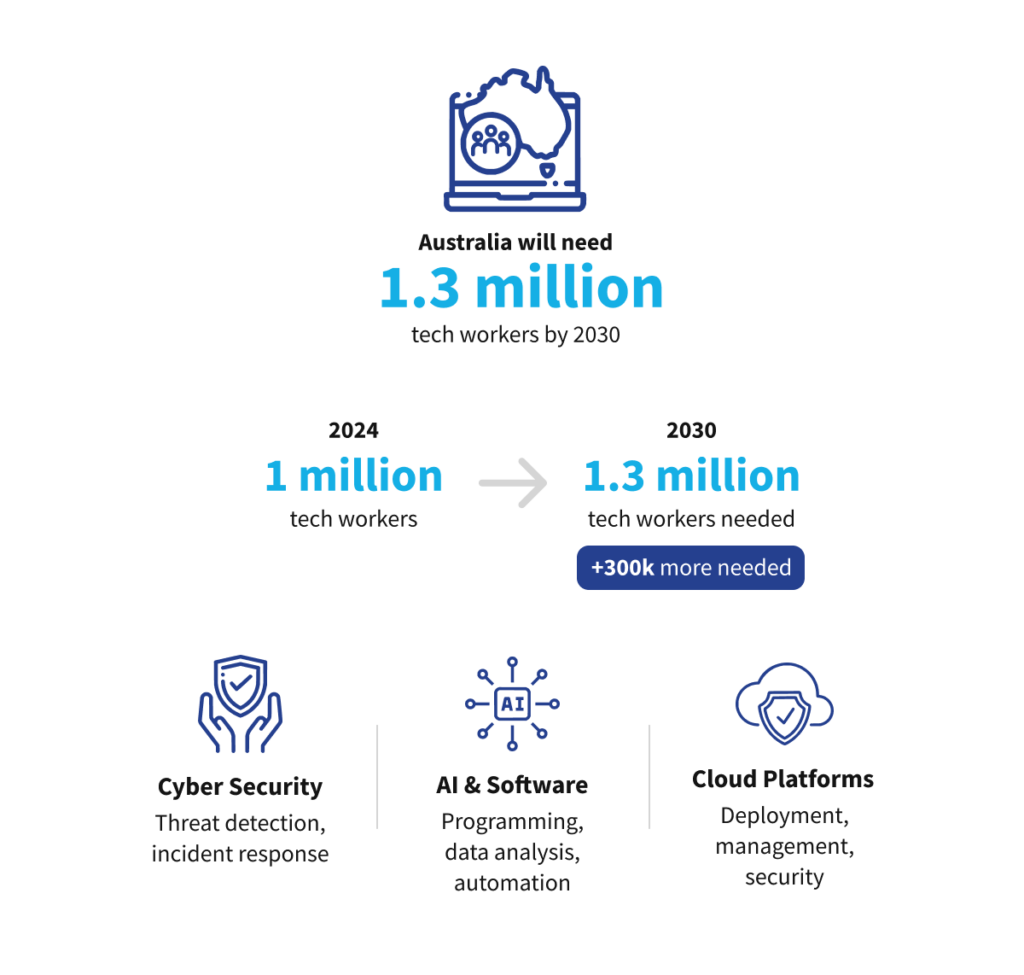
Source: ACS
Why Internal IT Teams Struggle to Build Deep Expertise Alone
Modern IT environments require expertise across multiple domains simultaneously. Cloud platforms, cyber security, identity management, compliance frameworks, networking, collaboration tools, and endpoint protection all require continuous attention and ongoing learning.
Most internal teams operate with limited headcount. They prioritise availability and user support because these needs remain constant. Strategic initiatives and skill development often take a backseat to immediate operational pressures. Over time, this creates a gap between what the business needs and what the internal team can realistically deliver.
Hiring specialists is an obvious solution, but it introduces costs, recruitment delays, and ongoing dependency on individual skill sets. When one person holds critical knowledge, the organisation becomes exposed during leave, after-hours incidents or unexpected departures.
Co-managed IT services recognise that expertise does not need to sit permanently inside the organisation to be effective. Instead, organisations can draw on specialist capabilities when required, while internal teams retain ownership of systems, relationships, and priorities.
What Makes Co-Managed IT Services Different From Outsourcing
Co-managed IT services differ fundamentally from traditional outsourcing models. Outsourcing transfers responsibility and control to a third party. Co-managed IT shares responsibility while control stays in-house.
Under a co-managed model, the internal team continues to define strategy, approve changes and own key systems. The external partner supports delivery by supplying capacity, tools and specialist expertise within clearly defined boundaries.
This approach avoids the common risks associated with outsourcing, such as loss of visibility, reduced internal capability or dependency on external providers for day-to-day decisions. Instead, co-managed IT services strengthen internal teams by giving them access to support that adapts to changing needs.
The model works because it respects existing knowledge and processes. Internal teams remain accountable for outcomes, while the co-managed partner contributes experience, scale and operational maturity.

Five Areas Where Co-Managed IT Services Deliver the Most Value
Co-managed IT services deliver the greatest impact in areas where internal teams experience sustained pressure or intermittent spikes in demand:
Specialised expertise on demand
Internal teams maintain control of their environment while gaining access to certified specialists across cyber security, cloud, networking, collaboration and endpoint management. This depth supports informed decision-making and faster issue resolution without requiring permanent hires.
Co-managed IT services also support practical compliance requirements. Rather than treating frameworks like ISO27001 as abstract standards, specialist guidance focuses on readiness, remediation and evidence management that fits operational reality.
Amplifying day-to-day operations
Routine service work absorbs a large portion of the internal team’s capacity. Co-managed IT services reduce this burden by providing overflow and after-hours service desk support, along with continuous monitoring of servers, networks and critical services.
This operational support reduces ticket backlogs, improves response times and allows internal teams to focus on roadmap delivery rather than constant interruption.
Access to enterprise-grade tools and platforms
Enterprise tooling often remains out of reach for smaller internal teams due to cost and administrative overhead. Co-managed IT services provide access to mature platforms for monitoring, asset management, licence tracking, security orchestration and reporting.
Internal teams retain visibility and access, while the co-managed partner manages administration and automation. This improves consistency and insight without introducing additional platform complexity.
Strategic advisory and roadmapping
Co-managed IT services extend beyond operational support. Regular engagement with experienced advisors helps align technology investment with business priorities.
Through structured reviews and roadmap planning, internal teams gain data-driven insights that support sensible sequencing, budget control and outcome measurement. Decision-making stays internal, while expertise and momentum come from the partnership.
Project and vendor management
Major initiatives often strain internal capacity. Office relocations, cloud migrations, wireless upgrades and security remediation require additional hands and disciplined delivery methods.
Co-managed IT services provide project resources and proven delivery frameworks that support timely execution. They also coordinate third-party vendors, reducing the operational load on internal teams and improving accountability across suppliers.

Compliance, Security and Risk Management in a Co-Managed Model
Compliance and cyber security place sustained pressure on internal teams, particularly in regulated industries. Requirements evolve, threats increase, and evidence obligations grow.
Co-managed IT services strengthen security posture through continuous monitoring, proactive remediation and specialist oversight. Internal teams retain governance and risk ownership, while the co-managed partner supports execution and documentation.
This shared model improves consistency and reduces reliance on individual expertise. It also supports audit readiness by keeping controls, policies and evidence current without creating an administrative burden for internal staff.
By integrating security into daily operations rather than treating it as a standalone project, co-managed IT services help organisations manage risk more effectively over time.
When Co-Managed IT Services Are the Right Fit for Your Business
Co-managed IT services suit organisations that already have an internal IT function but face pressure across capacity, skills or continuity.
They work well when teams spend most of their time on reactive support and struggle to progress strategic initiatives. They also suit environments where specialist skills are required intermittently rather than full-time.
Organisations managing compliance obligations, multi-site operations or ongoing transformation often benefit most from a co-managed model. The approach provides flexibility without sacrificing control or internal capability.
Turning Co-Managed IT Into a Competitive Advantage
When implemented well, co-managed IT services move beyond support and become a strategic advantage. Internal teams operate with greater confidence, better insight and stronger resilience.
Access to specialist expertise improves decision quality. Additional capacity stabilises operations. Enterprise tooling enhances visibility. Together, these outcomes allow organisations to move faster and reduce risk without expanding fixed headcount.
Rather than replacing internal teams, co-managed IT services amplify their impact and extend their reach.

Conclusion
Co-managed IT services address a fundamental challenge facing modern organisations. They deliver specialist expertise, operational scale and strategic support without removing control from internal teams.
By sharing responsibility in a structured manner, organisations strengthen their resilience, improve delivery, and maintain ownership of their technology environment. For businesses seeking capability without compromise, co-managed IT services offer a practical and scalable path forward.
BITS Works Alongside Internal Teams to Deliver Tailored Co-Managed IT
If your internal IT team needs additional capacity or specialist expertise without sacrificing control, a co-managed IT approach may be the next right step. A structured assessment can identify where support will deliver the most value while preserving existing workflows and accountability.
Through proactive operations, strong security fundamentals, and transparent reporting, our teams help organisations improve resilience, meet compliance obligations, and deliver more with existing resources.
Contact BITS to explore a co-managed model that aligns with your business priorities.